High speed inkjet is reshaping commercial, packaging, publishing, and transactional printing. But speed alone does not define a strong system. Print quality, uptime, substrate flexibility, drying control, and workflow automation often decide whether a press succeeds on a busy production floor. What are the key features of high speed inkjet systems? This question deserves a practical answer, not a list built around impressive specifications.
Frank Romano, a respected printing-industry educator and analyst, has said, “Inkjet is not a technology; it is a platform.” That perspective remains useful. Modern systems combine printheads, inks, software, data management, and finishing equipment. Their value appears in real details: stable color across a long run, readable one-point text, quick job changes, and fewer manual interventions. A reliable press should also handle variable data without slowing dramatically.
Speed matters.
However, comparing machines is rarely simple. A published speed may depend on paper weight, image coverage, resolution, and drying conditions. An operator may see excellent output at a showroom, then face different results with recycled stock or humid air. This is where experience matters. The best evaluation includes production trials, maintenance records, ink consumption, and operator feedback.
This introduction examines ten important features of high speed inkjet systems, including productivity, image quality, automation, connectivity, media support, and total operating cost. It also considers limitations. Faster equipment can increase waste when setup controls are weak. More automation can create new training demands. These trade-offs deserve attention before any purchasing decision.
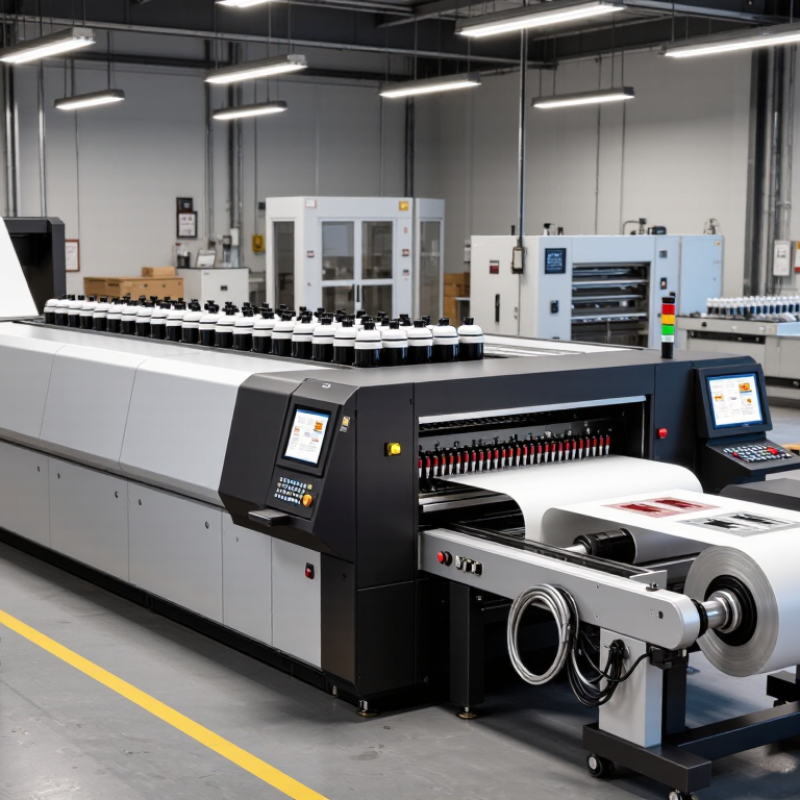
What Are the Top 10 Features of High Speed Inkjet Systems?
Core Components That Enable High-Speed Inkjet Printing
High-speed inkjet systems depend on ten connected features, not speed alone. Precision printhead arrays place thousands of droplets across each moving sheet. A stable ink delivery system maintains pressure, temperature, and viscosity during long production runs. Fast image processing converts variable data into accurate firing instructions. Reliable motion control keeps the substrate moving smoothly beneath the print zone.
Drying matters greatly. Airflow, heat, or other controlled curing methods must prevent smearing without damaging sensitive media. Automated registration corrects small shifts between colors, pages, or finishing marks. Advanced substrate handling reduces wrinkles, skew, and uneven contact. Small errors become visible quickly.
Sensors monitor ink levels, nozzle performance, web position, and drying conditions. Control software uses this data to adjust print density and detect defects. Maintenance tools, including nozzle cleaning and guided inspection, protect uptime and print quality. These features work together like a tightly tuned production line.
In practical operation, even strong systems need thoughtful setup. Dust, humidity, and paper variation can change results. Operators should verify test patterns before full production. A missed nozzle may remain unnoticed on one design but become obvious on a solid color field. Energy use and maintenance time also deserve measurement, because maximum speed can increase operating costs. The best configuration is not always the fastest one.
| No. | Key Feature | Representative Data or Capability | Core Components | How It Enables High-Speed Printing |
|---|---|---|---|---|
| 1 | High-Density Printhead Array | Fixed-array systems commonly use hundreds to thousands of individually controlled nozzles, with native resolutions typically ranging from 600 to 1,200 dpi. | Industrial piezoelectric printheads, nozzle plates, drive electronics, and waveform controllers. | A full-width or near-full-width array prints across the web without repeated carriage movement, allowing continuous production at high line speeds. |
| 2 | Multi-Channel Ink Delivery | Separate channels are normally provided for cyan, magenta, yellow, and black; some systems add specialty or spot-color channels. | Ink tanks, pumps, filters, dampers, tubing, pressure regulators, and degassing units. | Stable ink pressure and continuous recirculation maintain consistent droplet formation during long, uninterrupted production runs. |
| 3 | High-Frequency Droplet Ejection | Industrial piezoelectric heads can operate at firing frequencies from tens of kilohertz to above 100 kHz, depending on ink, drop size, and printhead design. | Piezoelectric actuators, firing chambers, waveform generators, and drop-monitoring controls. | Higher firing frequency allows more droplets to be placed per second while preserving image coverage at elevated media speeds. |
| 4 | Precision Media Transport | Web-fed systems may support media speeds from approximately 75 to 300 m/min, while sheet-fed systems use synchronized sheet transport and registration. | Servo motors, drive rollers, vacuum belts or drums, bearings, encoders, and transport controllers. | Accurate motion control keeps the substrate at a constant velocity and maintains the correct distance between successive ink drops. |
| 5 | Closed-Loop Registration Control | Optical or encoder-based feedback continuously measures position, skew, stretch, and color-to-color alignment. | Line-scan cameras, registration marks, rotary encoders, servo drives, and control software. | Automatic correction compensates for media movement and mechanical variation without requiring frequent manual stops or adjustments. |
| 6 | Advanced Drying or Curing | Water-based systems commonly use heated air and air impingement; UV or LED-UV systems cure ink using ultraviolet energy, depending on the application. | Hot-air dryers, infrared or near-infrared heaters, air knives, UV lamps, LED arrays, and exhaust systems. | Rapid drying or curing prevents set-off, smearing, and blocking, enabling printed material to be rewound, stacked, or finished immediately. |
| 7 | Real-Time Image Processing | Production controllers process variable data, raster images, color separations, and job information at the line speed required by the press. | Raster image processors, high-speed servers, print controllers, RIP software, and data interfaces. | Fast data preparation prevents the print engine from waiting for files and supports variable-content production without reducing throughput. |
| 8 | Automatic Nozzle Compensation | Software can detect missing or weak nozzles and redistribute neighboring drops or adjust image data to reduce visible streaks. | Nozzle-test routines, optical inspection, drop sensors, compensation algorithms, and printhead control electronics. | The system maintains acceptable image quality while continuing to run, reducing interruptions caused by isolated nozzle performance changes. |
| 9 | Automated Printhead Maintenance | Typical functions include scheduled wiping, capping, purging, spitting, ink recirculation, and controlled temperature management. | Wipe systems, service stations, caps, purge pumps, waste-ink tanks, and maintenance controllers. | Automated maintenance reduces operator intervention, limits nozzle blockage, and supports stable operation over extended production periods. |
| 10 | Inline Quality Inspection | Cameras can monitor registration, density, streaks, missing nozzles, color consistency, and print defects while the job is running. | Line-scan cameras, LED illumination, spectrophotometric sensors, defect-detection software, and feedback controls. | Defects are identified at production speed, enabling rapid correction and reducing waste without relying solely on offline inspection. |
Note: Representative operating ranges vary according to printhead architecture, ink chemistry, substrate, image coverage, drying method, and system configuration.
Stable ink delivery depends on pressure control, fine filtration, degassing, viscosity control, and recirculation. A clean ink path helps prevent pale bands and uneven coverage. Small changes matter.
Fine filters capture particles before they enter narrow ink channels. Blocked channels can cause missing marks or uneven drop placement. Inspect filters before quality declines.
Degassing removes air bubbles from the ink supply. Bubbles may interrupt firing without warning. The defect can look random.
Viscosity changes can affect drop size, edge sharpness, and coverage. Temperature and operating conditions may influence viscosity. The setting may seem correct, yet results can drift.
Automatic nozzle checks can identify missing or unstable firing. A blocked nozzle may create a thin white line across a dark image. Short tests can miss it.
No. Targeted cleaning may reduce problems, but it cannot repair every damaged nozzle. Aggressive purging can waste ink without solving the fault. That weakness deserves review.
Automated job setup reduces repeated data entry and manual mistakes. Variable data tools support personalized output without stopping production. Closed-loop checks can monitor density, registration, and missing marks.
Network integration can send approved files directly to the print queue. Remote dashboards show speed, ink levels, alerts, and job status. Poor permissions can create confusion.
Check ink pressure during continuous operation, not only at startup. Record nozzle faults by shift and substrate type. Test the system after idle periods. Some faults appear only then.
No. Dust, rushed training, inconsistent files, and calibration errors can still cause downtime. Predictive alerts and guided cleaning reduce guesswork. They are not magic.
High-speed inkjet systems combine precision hardware, advanced printheads, reliable ink delivery, and intelligent software to produce high volumes of printed material with consistent quality. What are the key features of high speed inkjet systems? They include fast print speeds, efficient throughput, workflow control, dependable nozzle performance, accurate drop placement, and stable operation across demanding production schedules. These systems are designed to minimize interruptions while maintaining sharp text, smooth graphics, and consistent color results.
Another important strength is their flexibility. High-speed inkjet systems can support a range of media types, paper weights, and application requirements through adaptable ink and printhead technologies. Automation features help manage job setup, monitoring, quality checks, and maintenance, while connectivity enables integration with digital workflows and production management platforms. Together, these capabilities improve operating efficiency, reduce manual intervention, simplify maintenance, and help print providers achieve reliable output, scalable production, and predictable overall performance.

 Axis Print